Don't forget to return to your survey
and get your discount!
What is the Difference Between a Blunt and a Joint?
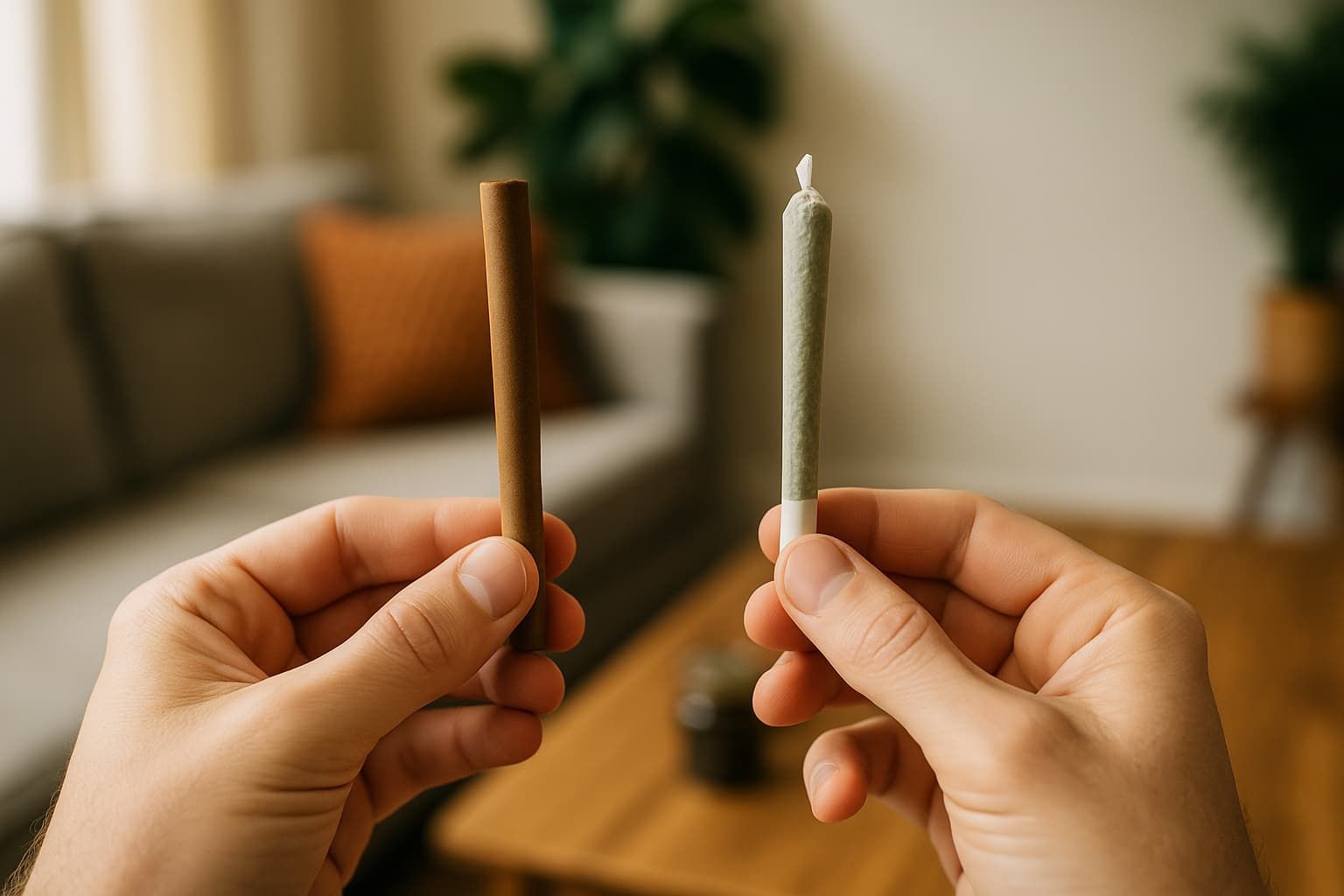
Cannabis culture is full of terminology, rituals, and preferences — and among the most commonly asked questions is: What’s the difference between a blunt and a joint?
At first glance, both are ways to roll up and smoke cannabis. But under the surface, the distinctions are meaningful. In terms of ingredients, experience, health implications, and social connotations.
Whether you’re a new user or a connoisseur, knowing the differences lets you choose what fits you best. Below, we break it all down with data, nuance, and no fluff.
Defining a Joint
A joint generally refers to cannabis rolled in thin, combustible rolling paper. These papers are often made of hemp, rice, wood pulp, or other plant fibres, and are designed to burn relatively cleanly. The essence of a joint is “pure cannabis,” with little to no added components beyond the herb.
In usage, joints tend to be modest in size. According to a study that analyzed more than 10,600 cannabis transactions over an 11-year span, researchers estimated that the average joint contains about 0.32 grams of cannabis. This is significantly lower than earlier estimates.
Some commercial pre-rolls, for convenience or potency, are made larger (e.g. 0.5 g, 0.75 g, or even 1 g), but home-rolled joints often stay closer to modest amounts.
Why Do People Prefer Joints?
Their appeal lies in their simplicity, discretion, and flavor purity. Because there’s no added tobacco wrap, joints tend to let the terpenes and nuances of the cannabis strain come through more cleanly.
They’re easier to carry, quicker to roll, and typically burn faster – making them ideal for solo use or short sessions.
Defining a Blunt
A blunt, by contrast, is cannabis rolled in a cigar wrap or tobacco leaf (or re-purposed cigarillo shell). In effect, a blunt is a fusion of cannabis and tobacco (or at least tobacco wrapper). It brings in a different smoking profile, both in chemistry and sensation.
Historically, blunts gained popularity in U.S. urban culture during the 1990s and early 2000s, especially within hip-hop communities, as artists and youth embraced “rolling up” using cigar shells.
Over time, it became more than a smoking method — it became a cultural symbol.
Why Do People Prefer Blunts?
Size-wise, blunts often hold much more cannabis than joints. While there isn’t a universally accepted average weight for a blunt (because wraps vary), many are designed for 1–2 grams or more of cannabis. The tobacco leaf shell also burns slower and is thicker, letting more volume be packed in.
One additional dimension: because the wrapper is tobacco-based, there may be nicotine or tobacco-derived compounds introduced into the smoke, which have health and experience implications (we’ll come back to that).
Key Differences Between Blunts and Joints
Let’s compare side by side the main axes of difference:
1. Size & Capacity
- Joints tend to be smaller, often 0.2 to 0.5 grams (in home rolls) or up to 1 gram in commercial formats.
- Blunts can handle more volume — 1 gram or more — making them better suited for longer sessions or group sharing.
2. Wrapper Material & Additives
- A joint uses plain rolling paper, which is neutral (transparent to cannabis flavor) and adds minimal additional chemicals.
- A blunt uses a tobacco or cigar wrapper, which introduces its own set of flavor compounds (and sometimes nicotine).
3. Burning Behavior & Duration
- Joints burn faster and more evenly (though they may canoe or run depending on the roll).
- Blunts burn slower, often more steadily, and last longer due to thicker wrapper and higher mass.
4. Flavor & Experience
- Joints tend to offer a cleaner, more direct cannabis taste — ideal for savoring delicate strain flavor profiles.
- Blunts carry a stronger, earthier, sometimes spicy or herbal note (thanks to the wrapper), and often are experienced as more “robust.”
5. Cultural & Social Context
- Joints are often seen as classic, bohemian, or solo-friendly — more personal and intimate.
- Blunts carry social overtones: rolling for gatherings, a communal experience, and stronger street/hip-hop cultural connections.
Pros and Cons: Joint vs Blunt
Here’s a quick pros/cons breakdown to help readers choose:
| Feature | Joint — Pros | Joint — Cons | Blunt — Pros | Blunt — Cons |
|---|---|---|---|---|
| Simplicity / Ease | Easy to roll, small materials | Burns fast, less forgiving | More forgiving roll for groups | More materials needed, bulkier |
| Taste / Purity | Cleaner, more cannabis-forward | Less “body” to smoke | Richer flavor, fuller experience | Tobacco wrapper may muddy flavor |
| Duration / Session | Ideal for short solo use | Not ideal for long sessions or sharing | Lasts longer, good for group | Too much for casual users |
| Health / Chemical Exposure | Only cannabis combustion | Still smoke; lung irritation possible | Combustion + wrapper chemicals | Increased chemical exposure, possible nicotine |
| Social / Cultural | Intimate or low-key use | Less dramatic theatrics | Social, bold, communal | May feel heavier or more aggressive |
In essence: if you're after purity, discretion, and flavor clarity, a joint might be your best bet. If you want to linger longer, share with friends, or lean into a fuller smoke, a blunt might serve better, but with added trade-offs.
Which Is Better and When?
There’s no universal “better”. The choice depends on your priorities:
- Flavor-first / strain-savvy users: joints often shine.
- Social or shared sessions: blunts can stretch the smoke out and invite conversation.
- Health-conscious users: joints may carry fewer additive risks (though any smoke has inherent respiratory concerns).
- Beginners or casual users: a joint is less intimidating and more controllable.
- Those with higher tolerance or wanting longer sessions: blunt is an option, but consider moderation.
Also worth noting: consumer trends are shifting.
The pre-roll segment (commercial joints and cones) is arguably the fastest-growing area in the legal cannabis industry. Between June 2023 and June 2024, pre-rolls recorded an 11.89% revenue increase, outperforming other categories.
In the same span, pre-rolls moved $4.1 billion in sales and sold over 394 million units across 12 U.S. states. That growth suggests many users favor convenience, consistency, and portability. These are elements more aligned with joint-style delivery than blunts.
Conclusion
At first glance, blunts and joints might seem interchangeable. But dig deeper, and the differences — in wrapper, smoke chemistry, duration, flavor, and health implications — are clear and meaningful. Joints offer a lean, flavor-forward, and clean experience; blunts lean heavy, communal, and bold.
Ultimately, your choice should match your session type, comfort level, and health priorities. Want to try both? Explore responsibly, and experiment with small amounts to see what you prefer.
Shop Blunts and Joints with Fiori Delivery
Looking to try both blunts and joints for yourself?
At Fiori Delivery, a licensed weed dispensary in Sacramento, we carry a wide selection of pre-rolls, premium flower, extracts, and smoking accessories to match any preference. Whether you’re after the clean, terpene-rich taste of a joint or the slow-burning, full-bodied experience of a blunt, we’ve got you covered.
Browse our menu, place your order online, and enjoy same-day delivery — fast, discreet, and hassle-free.
Don't forget to return to your survey
and get your discount!
SHARE