Don't forget to return to your survey
and get your discount!
What Is TAC In Weed?
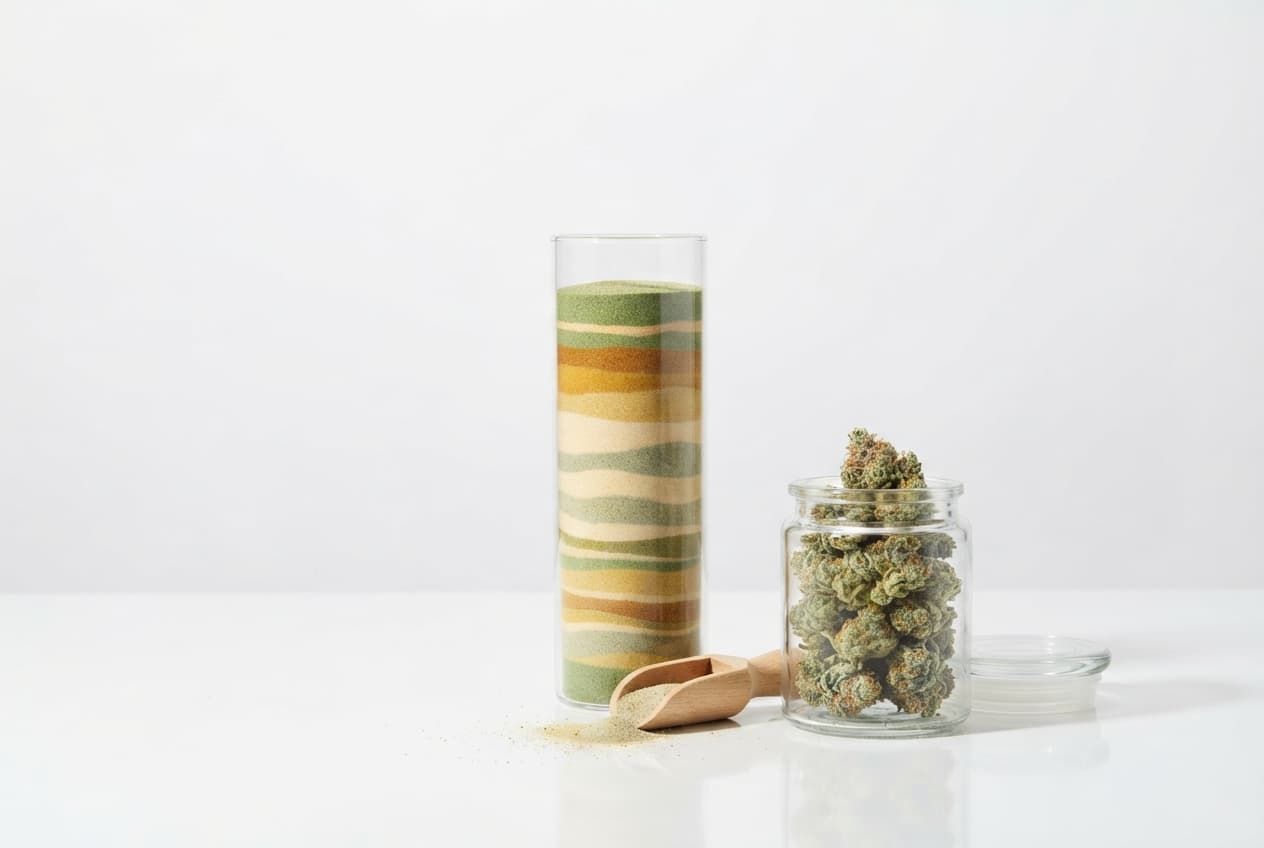
What is TAC in weed? TAC stands for Total Active Cannabinoids, the combined percentage of every active cannabinoid a lab finds in a cannabis product. It usually appears on labels right next to THC, and the two numbers rarely match.
That's because THC is a single cannabinoid, while TAC adds up all of them, including THCA, CBD, CBG, and others. Between THC, Total THC, and TAC, a single label can show three different potency figures, and it isn't obvious which one matters.
This guide explains what TAC measures, how it differs from THC, and how to read it on a real label so you can compare products with confidence.
TAC vs THC: What's Actually the Difference?
THC is a single cannabinoid. TAC is the total of all of them, which is why the TAC vs THC numbers on a label rarely match.
Think of a nutrition label. Sugar is one line item, and total carbohydrates is the bigger number that includes it. THC is the sugar. TAC is the total carbs.
TAC adds up every cannabinoid the lab measures: THC, THCA, CBD, CBG, CBN, CBC, and more. Since THC is part of that sum, TAC is always equal to or higher than THC. A higher TAC isn't a mistake. It means other cannabinoids are present.
Flower labels often add another number, Total THC, which makes sense once you understand THCA.
What Is THCA, and Why Does It Change the Numbers?
THCA is the reason a flower label can show more than one THC number.
In raw cannabis, most of the THC isn't THC yet. It's THCA, a compound that does nothing noticeable until it's heated. When you smoke, vape, or cook the flower, heat converts THCA into active THC. (That process is called decarboxylation.)
So a flower label usually shows two THC figures:
- THC: What's already active in the flower as tested. This number is usually small.
- Total THC: What the flower can deliver once heated. It adds the THC to the THCA that will convert, so it's the number most buyers care about.
TAC counts THCA too, since it becomes active THC when heated. That's why TAC usually comes out higher than both THC figures.
The conversion isn't a one-to-one swap. THCA loses about 12% of its weight as carbon dioxide when it converts, so labs multiply the THCA percentage by 0.877 to calculate Total THC. The label section below walks through a full example.
How to Read the Numbers on a Real Label
To estimate how much THC a flower can deliver, check Total THC. For the overall cannabinoid content of any product, check TAC.
You'll find both on the lab report (called a COA, or certificate of analysis), the packaging, and online menu listings. "TAC" can also stand for Total Aerobic Count, a microbial safety test. If it appears next to terms like yeast and mold, it has nothing to do with potency.
Here's a hypothetical flower label. The figures are made up for illustration.
- THCA: 24.5%
- THC (Delta-9): 0.6%
- Other cannabinoids (CBD, CBG, CBN, CBC): 1.2%
- Total THC: 22.1%. This is the THCA converted (24.5% × 0.877 = 21.5%), plus the 0.6% THC.
- TAC: 26.3%. This is THCA, THC, and the other cannabinoids added together, with Total THC left out.
Small gaps between numbers on a real label are normal. Labs round their results, and some report TAC as a straight sum while others adjust it for conversion.
Compare like with like: Total THC to Total THC, and TAC to TAC.
Does a Higher TAC Mean Better Weed?
No. TAC is not a quality score. It measures a product's cannabinoid content by weight, and nothing else.
Here's what that number can't tell you:
- Aroma and flavor: Terpenes, the aromatic compounds behind a product's smell and taste, aren't counted in TAC. Two products with the same TAC can smell and taste very different.
- Freshness: Terpenes fade as flower ages, and TAC won't show it. A fresh, well-cured flower with a modest TAC can be more enjoyable than a stale one with a bigger number.
- Fit for you: Your tolerance matters more than the biggest number on the shelf.
Say one flower tests at 28% TAC and another at 24%. The 28% looks stronger, but if the 24% is fresher and more aromatic, it may be the better pick.
Use TAC to compare potency between similar products, such as two flowers. Don't use it to judge overall quality.
What's a "Normal" TAC? Flower vs. Concentrates vs. Vapes
An 80% TAC is normal for a concentrate but would be far outside the range for flower. What counts as high depends on the product type.
- Flower: High teens to low thirties. Related read: Why 25% THC Sungrown Flower Is Perfect for Everyday Use.
- Concentrates: 60% up to the 90s, because they're refined to concentrate cannabinoids. Related read: What Is Cured Resin?
- Vape oils: 70% to 90%. Vape oil is a type of concentrate, so these ranges overlap.
These are broad ranges, not hard rules. Strain, producer, and batch all change the numbers, so the lab report for your specific product is the best reference.
That's why TAC only makes sense within a category. Compare flower to flower, and concentrate to concentrate.
Bottom Line
TAC is the total cannabinoid picture, and THC is one piece of it. Neither number is a quality score. Both tell you how much cannabinoid content a product has, not how good it is.
Next time you're comparing products, check Total THC or TAC, match like with like, and read the lab report for the specific product in front of you.
When you're ready to shop, browse Fiori Delivery's menu, with same-day delivery available in Sacramento.
Frequently Asked Questions
What does TAC stand for in weed?
Total Active Cannabinoids. It's the combined percentage of every active cannabinoid a lab finds in a product.
What does TAC mean on a cannabis label?
It shows a product's total cannabinoid content as a percentage by weight. Look for it on the packaging, the online menu listing, and the lab report (COA). Compare it only with products of the same type.
What is the difference between TAC and THC?
THC is one cannabinoid, while TAC adds up all of them, so TAC is always equal to or higher than THC on the same product. On flower, labels often also show Total THC, which is the THC you can expect once the flower is heated.
Does TAC include CBD?
Yes. CBD is one of the active cannabinoids TAC adds up, and it's usually listed on its own line too.
What is a high TAC in weed?
It depends on the product type. For flower, the upper twenties and above is high. Concentrates, including vape oils, commonly run from 60% up to the 90s. Compare within the same category.
Is a higher TAC always stronger?
Not necessarily. A higher TAC means more cannabinoid content by weight, but it doesn't tell you about aroma, freshness, or how well the product suits your tolerance. Use it to compare potency between similar products, not to judge quality.
Don't forget to return to your survey
and get your discount!
SHARE